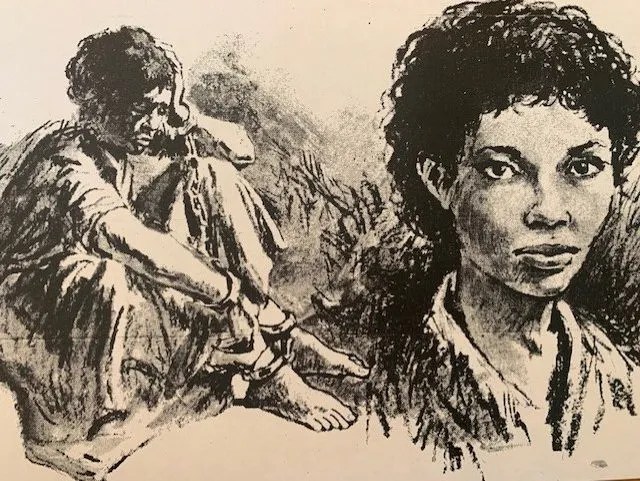
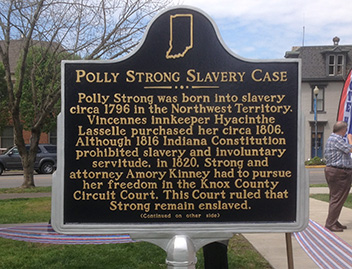
The story of Polly Strong begins with her mother, Jenny, who was abducted by Indigenous individuals at the age of fifteen, and enslaved prior to the Northwest Ordinance of 1787. Following the Treaty of Greenville in 1795, Jenny was sold to Antoine Lasselle, a French fur trader residing near modern day Fort Wayne. While enslaved by Antoine Lasselle, Jenny gave birth to at least two children: Polly, born in 1796, and James, born around 1800. Polly was initially sold to a man named Joseph Barron, while James was sold to a “a certain La Plant”, according to Knox County court records. In 1806, Hyacinthe Lasselle, Antoine Lasselle’s nephew, purchased Polly. He later acquired James.
Despite the illegality of their enslavement being reinforced by the Indiana State Constitution of 1816, Lasselle continued to hold the Strong siblings in bondage. The siblings’ fight for freedom began in 1818, when their mother, with the assistance of attorney Moses Tabbs, filed a petition for a writ of habeas corpus in the Knox County Court. While the exact manner in which Jenny initially contacted Tabbs is unclear, her petition, aimed at securing freedom for her children, forced Lasselle to bring the Strong siblings before the Knox County Court. There, he was required to justify their continued enslavement. The petition presented to the court detailed both Jenny’s forced enslavement and the illegal bondage of her children under Lasselle. As detailed in the petition, with Jenny being referred to as the Petitioner, “…your Petitioner was taken prisoner many year since by a hostile tribe of Indians and kept in bondage by them until some time after the Treaty of Greenville in the year 1795. That some time after…your Petitioner was sold by said Indians to a certain Antoine Lasselle, and that whilst your Petitioner was in the service…of said Antoine Lasselle, she had two children James and Polly. That the said Antoine Lasselle unjustly claiming your Petitioner as well as her children as his slaves, sold the said Polly to a certain Joseph Barron and that said Barron has since sold said Polly to Hyacinthe Lasselle, in where with him she is at present unjustly and unlawfully detained. That the said Antoine Lasselle unjustly claiming your Petitioner and her children as aforesaid sold the said James to a certain La Plant who sold said James to Hyacinthe Lasselle…” (Moses Tabbs, 1818).
Both parties appeared before Judge Thomas Holdsworth Blake on August 4th, 1818. Lasselle presented documents to redefine the Strong siblings as indentured servants, which they had signed on July 16th, 1818. These documents were intended to demonstrate that the Strong siblings had consented to continue serving Lasselle as indentured servants. However, Moses Tabbs argued that the indentures were signed under duress, while the siblings were confined and coerced by Lasselle. In May of 1819, the writ of habeas corpus petition was dismissed. However, the lack of surviving documentation about the dismissal makes it difficult to determine the factors that led to this outcome, as well as why the Strong siblings ultimately were not reclassified as indentured servants. Furthermore, James disappears from formal documentation regarding the fight for freedom from Lasselle after the writ of habeas corpus petition was dismissed. His fate remains unknown.
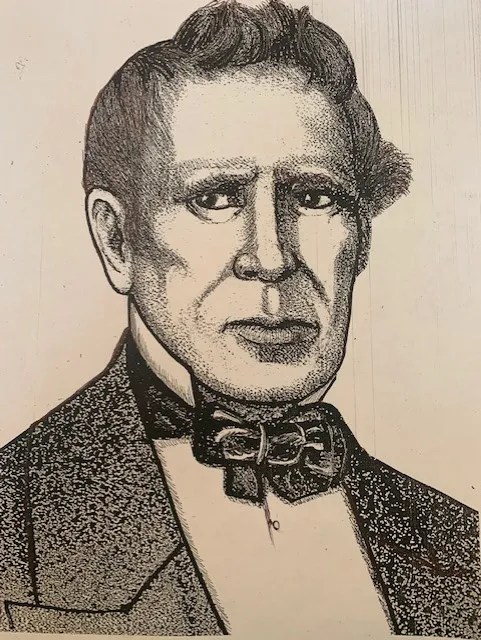
In January of 1820, Amory Kinney, an attorney from Vermont who moved to Indiana in 1819, began assisting Polly Strong in her fight for freedom. Kinney worked closely with Moses Tabbs and his brother-in-law, John W. Osborn, who served as his legal partner. Together, they filed a formal lawsuit in the Knox County Circuit Court against Lasselle to secure Strong’s freedom. In the lawsuit against Lasselle, Kinney’s argument was grounded in Article Six of the Northwest Ordinance of 1787. Kinney contended that, since Strong was born in the Northwest Territory after the Northwest Ordinance was enacted, she should be considered free. The trial for Strong’s case took place on May 1st, 1820, alongside that of another enslaved individual, Francis Jackson. Jackson, like Strong, was born after the passage of the Northwest Ordinance but was the child of a woman enslaved before 1787, putting him in a comparable position from a legal standpoint.
The Knox County Circuit Court determined that both Strong and Jackson were to remain enslaved. The Court’s decision was based on the assumption that the legal status of individuals enslaved prior to the Northwest Ordinance remained unchanged, as they believed that the anti-slavery laws presented in the Northwest Ordinance were not retroactive. The court held that enslaved children followed the status of their mothers, which led them to rule that Strong and Jackson were not entitled to freedom, as both of their mothers had been enslaved prior to the Northwest Ordinance. When confronted with the idea of freeing their mothers, the Court stated that freeing them would, “…be not only contrary to the spirit of all our laws but would be in open violation of the constitution of the United States which makes private property inviolable” (Knox County Circuit Court, 1820). Furthermore, when discussing the continued enslavement of children of enslaved women, the court announced, “In all states where slavery is tolerated and people of color are held as property, this is undeniably the fact…I know of no reason why it should not be the case here for as regards the situation of the mothers is of the present applicants, this is now a slave state…” (Knox County Circuit Court, 1820).
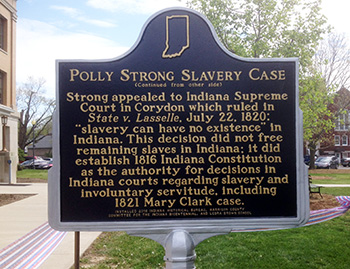
Twelve days after the Knox County Circuit Court ruled against Strong and Jackson, Strong and Jackson each filed separate appeals with the Indiana Supreme Court in Corydon. The higher court ruled in favor of Strong obtaining her freedom, agreeing with Kinney’s argument that her birth in the Northwest Territory after the enactment of the Northwest Ordinance exempted her from enslavement. When defending this decision through analysis of the 1816 Indiana Constitution, Supreme Court Justice John Scott asserted, “In the first article of the constitution, sec. 1 it is declared ‘That all men are born equally free and independent, and have certain natural, inherent, and unalienable rights’…In the 11th article of that instrument, sec. 7, it is declared that ‘There shall be neither slavery nor indentured servitude in this state’…It is evident by these provisions, the framers of our constitution intended a total and entire prohibition of slavery in this State; and we can conceive no other form of words in which that intention could have been more clearly expressed” (Indiana Supreme Court, 1820). Following the resolution of Strong’s case, Francis was also granted his freedom by the Indiana Supreme Court. On May 8th, 1821, the court ruled that Jackson’s situation mirrored Strong’s, and thus, he too should be freed in accordance with the earlier decision. The Indiana Supreme Court’s decision in the case of State v. Lasselle set a significant precedent for the abolition of slavery in Indiana, and the ruling provided was utilized in future court cases where enslaved individuals in Indiana sought freedom from their enslavers.
Additional Resources
McCormick, M. (2012). Historical perspective: Revisiting the struggles of Polly Strong. Tribune-Star. https://www.tribstar.com/news/lifestyles/historical-perspective-revisiting-the-struggles-of-polly-strong/article_86150825-8d63-594b-baca-b0e04080a032.html
Supreme Court of Indiana. (1820). The state v. Lasselle. State of Indiana. https://web.archive.org/web/20080721195500/http://www.in.gov/judiciary/citc/special/bound-for-freedom/lasselle-opinion.pdf
Adams, W. L. (n.d.). Bound for freedom: The case of Polly Strong. State of Indiana. https://web.archive.org/web/20080721195506/http://www.in.gov/judiciary/citc/special/bound-for-freedom/timeline.pdf
Knox County Circuit Court. (1820). Knox County Circuit Court record for Polly Strong. Knox County Public Library. https://indianamemory.contentdm.oclc.org/digital/collection/kcpl/id/43379
Moses Tabbs. (1818). Petition for writ of habeas corpus by Moses Tabbs. Knox County Public Library. https://indianamemory.contentdm.oclc.org/digital/collection/kcpl/id/43375
Polly Strong slavery case. (2016). Indiana Historical Bureau. https://www.in.gov/history/state-historical-markers/find-a-marker/find-historical-markers-by-county/indiana-historical-markers-by-county/polly-strong-slavery-case
 Slavery in Indiana