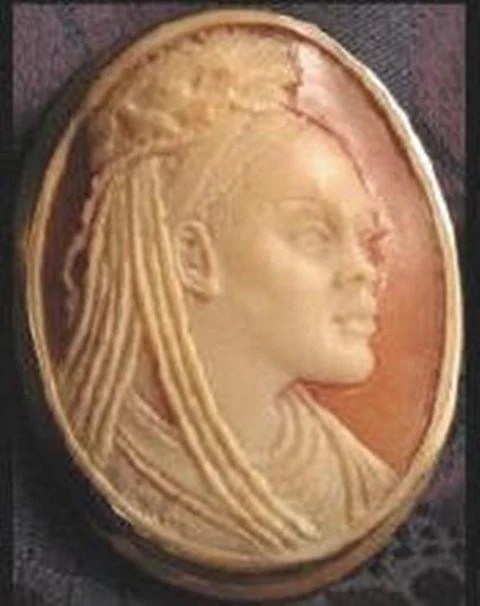
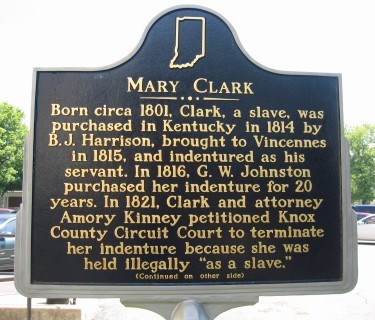
Shortly after the case of State v. Lasselle, the Indiana Supreme Court heard the case of Mary Clark v. G.W. Johnston, another pivotal legal battle that underscored the tensions between anti-slavery constitutional provisions and the persistence of involuntary servitude under the guise of indentured servitude. Mary Bateman Clark was born into slavery, and was sold in Kentucky to Benjamin J. Harrison in 1814. Harrison brought her to the Indiana Territory in 1815, and sold her in 1816 to General Washington Johnston, who was a member of the Indiana General Assembly. Clark was then bound to serve General Washington Johnston under a long-term indenture contract that mirrored many elements of slavery. Represented by the same legal team that had championed Polly Strong’s freedom, Clark argued that her contract violated the Indiana Constitution of 1816, which prohibited both slavery and involuntary servitude. Similarly to the case of State v. Lasselle, Clark was initially denied her freedom in the Knox County Circuit Court, and her case was appealed to the Indiana Supreme Court.
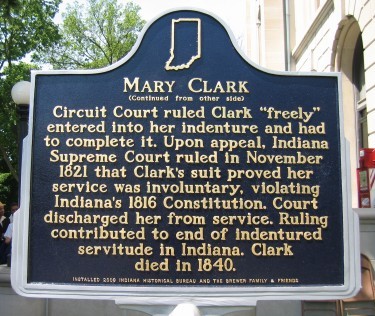
The Indiana Supreme Court ruled in favor of Clark in November of 1821, declaring her indenture contract unlawful, citing her presence in court as evidence that she did not voluntarily consent to becoming an indentured servant. Through this decision, the court affirmed that attempts to circumvent anti-slavery laws through long-term indenture contracts were incompatible with the constitutional prohibition against involuntary servitude. Together, the cases of State v. Lasselle and Mary Clark v. G.W. Johnston served to extend the constitutional promise of freedom beyond theoretical ideas to practical enforcement in court. However, while the rulings made in these cases did establish a crucial precedent that would influence future legal interpretations of anti-slavery laws, they did not automatically free other enslaved people and Black individuals bound to long-term indenture contracts in Indiana. They raised the odds that courts would rule in favor of freeing enslaved people and Black individuals bound to long-term indenture contracts, but many enslaved people and Black individuals under long-term indenture contracts did not have access to the legal assistance they would need to pursue their freedom in court. Therefore, slavery in Indiana, and the practice of binding enslaved people to long-term indenture contracts, persisted after the cases of State v. Lasselle and Mary Clark v. G.W. Johnson.
 Slavery in Indiana